
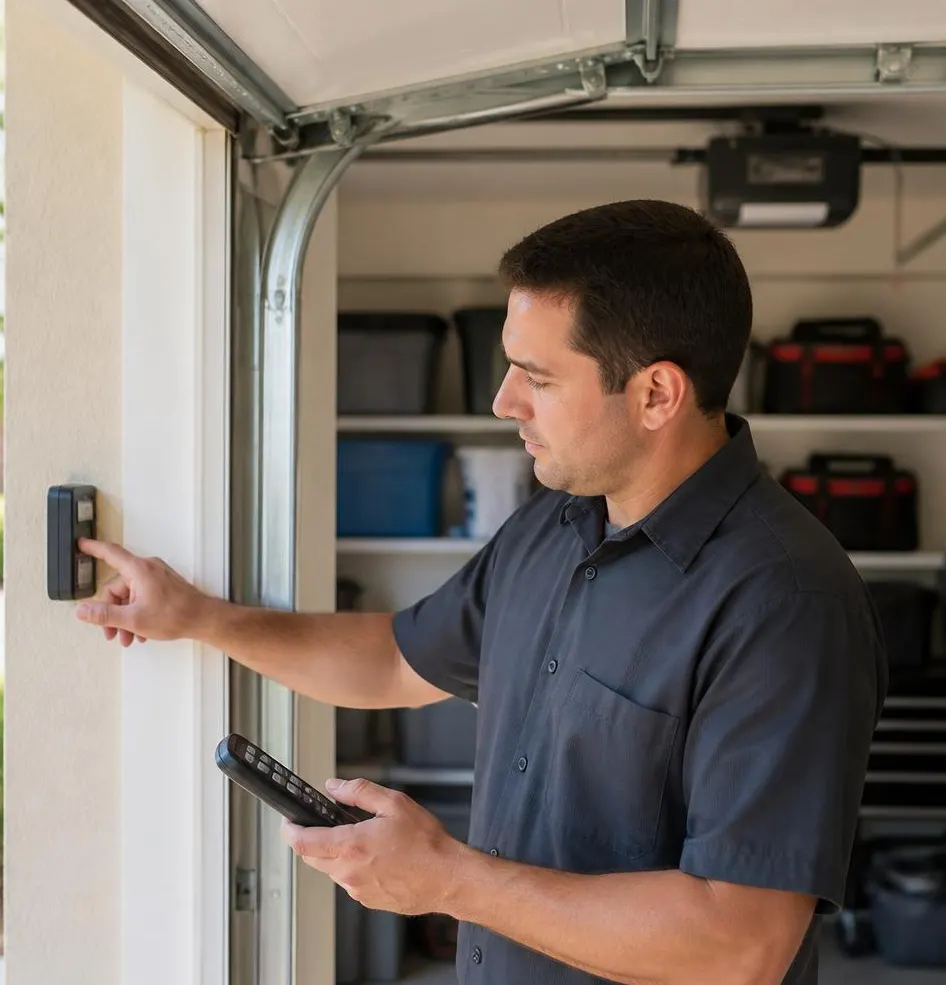
The short answer
If your opener is under 8 years old and the problem is one isolated part—a sensor, a remote, a capacitor, a worn gear—repair almost always wins on cost. If the unit is past 10 to 12 years old, or you've called for a second or third repair in the last two years, replacement is the cheaper path once you look at a five-year window instead of just today's bill. The rest of this comes down to how your specific opener is failing and how much the local weather has already worked against it.
What repair typically costs over five years
Most opener problems fall into a short list, and most of them are inexpensive on their own:
- Safety sensor failure or misalignment — often $75–$150 to diagnose and fix. Moisture and condensation on the sensor eyes are a common trigger here, especially during the wetter months.
- Worn drive gear or sprocket — usually $100–$200. This is a wear part on chain and belt drives alike and shows up as grinding noise or a door that won't fully close.
- Dead or failing circuit board — typically $150–$300. Boards are the part most vulnerable to humidity swings, and a garage that never fully dries out between rain events shortens their life.
- Remote or keypad malfunction — usually under $100.
- Capacitor or motor winding failure — can run $200–$350, and is often the first sign the motor itself is nearing the end of its life.
A single repair, even a $300 circuit board, is cheap compared to a new unit. The math changes when you're paying for two or three of these over a few years, because labor is charged each visit and the parts add up. If you're on your third service call in 24 months, you've likely already spent 40–60% of what a new opener would cost, with no warranty to show for it.
What replacement typically costs over five years
A new opener installation generally runs in the $350–$700 range for a mid-grade belt or chain drive unit with professional installation, more for smart, Wi-Fi-enabled, or battery-backup models. Once installed, a new unit typically needs nothing beyond basic maintenance for the first several years, so the five-year cost is close to the sticker price plus occasional lubrication and sensor cleaning.
The features that matter most for this climate are worth calling out specifically:
- Battery backup — keeps the door operable during power outages, which matters during winter wind and ice storms when outages are more common.
- Sealed or moisture-resistant circuit boards — newer units handle humid garages better than openers built 10+ years ago.
- Soft start/stop motors — less strain on the opener and on aging garage door springs, which matters if the door itself is also getting older.
The trade-offs that matter more than the sticker price
Cost isn't the only variable. A few things tend to tip the decision one way or the other:
- Age plus a single failure favors repair. A 4-year-old opener with a bad sensor doesn't need to be replaced.
- Age plus repeated failures favors replacement. Once a motor or board is failing, other components built in the same era are usually close behind.
- Chain-only, no battery backup units installed more than a decade ago are increasingly worth replacing proactively if outages during storm season have ever left you stuck outside or unable to get a vehicle out.
- Older wood-trimmed garage doors that have picked up moss, swelling, or slight rot can put extra strain on an opener that's struggling to lift a heavier-than-designed door. In that case, the opener might be fine—the door itself needs attention first, and replacing just the opener won't solve the real problem.
- Smart home features (phone app control, camera integration) are a want, not a need, but they do add resale value and convenience that's hard to retrofit onto an older motor.
The recommendation for typical homes here
For most homes in this area dealing with mild temperatures, long wet stretches, and the occasional ice or wind storm, the break-even point tends to land around the 10-year mark. Under that age, repair the specific failure and keep going. At or past that age, especially if you've already had one repair, the smarter five-year move is usually replacement with a unit that includes battery backup and a sealed board—both of which directly address the two things that cause the most trouble locally: power interruptions during storms and moisture getting into electronics that sit in a garage that rarely fully dries out.
When to call Tacoma Garage Door
If your opener is grinding, reversing unexpectedly, or failing to respond to the remote, our techs can usually diagnose the exact cause on the first visit and give you a straight answer on repair versus replacement rather than defaulting to either. We handle both Opener Repair & Installation and, where the opener's struggles trace back to a heavier or misbalanced door, Spring Replacement and door service to fix the root cause instead of masking it. We serve Tacoma, Lakewood, University Place, Fircrest, Puyallup, Federal Way, Gig Harbor, and Spanaway, and we can usually get a technician out fast if your door is stuck shut or open.
If your opener has been acting up, call Tacoma Garage Door for a straightforward repair-or-replace assessment before the next storm catches you with a door that won't move.